New “Hawaii Entomology” store on Cafepress
So tonight I created a store on Cafepress called “Hawaii Entomology.” The idea is that any money I make from items sold will go to support entomology in Hawaii. I haven’t quite decided who to give the money to, but I won’t worry about that until I actually have money to give. It will cost $7/month to keep the store going, so I guess we’ll see if I make at least that. I’ve got a couple of old designs in there (“Koebele Would Go” and “Hawaii Entomology”), but I also added a new one – its the cover of Proc Haw Ent Soc 1(1) from 1906. This is the idea that I had been mulling around, which I think I mentioned in my last post. I was thinking it would be cool to make T-shirt designs from the covers of classic texts in entomology. Unfortunately, I haven’ t really identified what those would be (and there could be some copyright issues), so for now I decided on the first issue of the Hawaiian Entomological Society Proceedings. You can check it here http://www.cafepress.com/HI_Ento/7122933 . On the back is the list of officers and members in 1905. I might order one for myself just to see how it looks on an actual shirt.
Here are the images:
Front Back

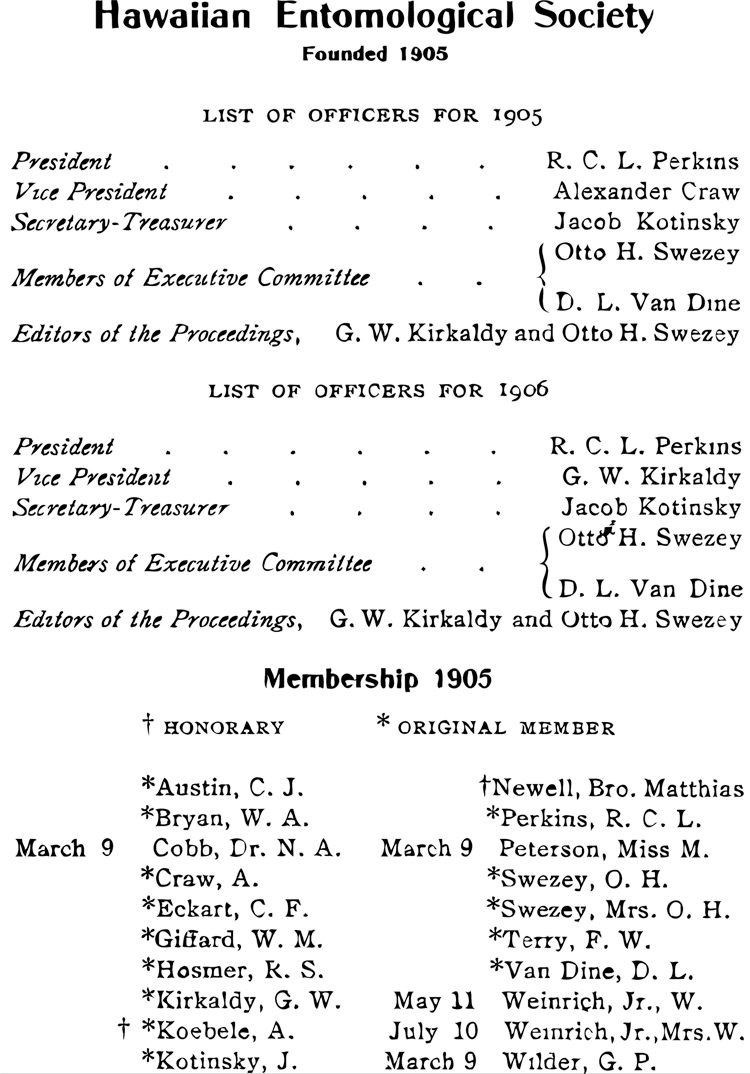
This store is a work in progress – I have some more ideas, but not enough time. So while it might be a little lame now, I hope to improve it over time.
Something odd caught my eye tonight as I was watching G4’s “Attack of the Show” gadget review segment…Chris Hardwick wearing an ant t-shirt?
Here is an image I lifted off YouTube:

At first I thought maybe it was an image of an ants book cover that had been turned into a t-shirt (I’ve been mulling over similar ideas lately…), but when I found a close-up image, it turns out this is a t-shirt from a California Academy of Sciences exhibit.

I did a little a little sleuthing on the internet and this t-shirt is no longer available at the California Academyof Sciences store. In fact, it appears that the “Ants: Hidden Worlds Revealed” exhibit was back in 2005, so this t-shirt is about half a decade old. I didn’t know much about Chris Hardwick (other than as the host of “Web Soup”) so I looked him up as well, and I guess it should be no surprise that he would sport such a cool shirt. In addition to his TV and comedy gigs, he is a self proclaimed science nerd and does science writing for Wired magazine. I think he may also have a thing for t-shirts since he sells some on his blog, The Nerdist – unfortunately, none are as cool as his California Academy of Sciences ant shirt.
Muno and Weezer outed as entophiles on Yo Gabba Gabba!
Yo Gabba Gabba is definitely one of my favorite shows to watch with my two-year old daughter – second only to Spongebob Squarepants. Caught this little song the other morning on YGG about bugs, and I had the tune going through my head for the rest of the day. So beware…if you watch the following video, someone at your workplace is going to catch you muttering “I like bugs, I like bugs…” while doing the robot dance. In the words of Jack Black, ” You rock, Muno!”
I didn’t see this next one on TV, but evidently Weezer also rocked the house at YGG with “All My Friends Are Insects.” It’s pretty awesome (even though earthworms are not insects). Unfortunately the Youtube video is poor quality. For some reason, I couldn’t embed the better version from Vopod, so you should definitely check it out here http://vodpod.com/watch/3210159-weezer-talks-about-their-friends-on-yo-gabba-gabba
Here is some more footage of Weezer jamming in the insect suits:
Entomology Fish/Bug Emblem
I’ve been tossing this idea around in my head for a while now about designing something like the Darwin version of the christian fish symbol, but with an entomology slant. As luck would have it, a freind of mine at work has a machine that makes chrome plated emblems for cars and whatever else one would put such a thing on, so I sketched out my idea and asked him if he could make me a prototype. Just yesterday he cranked it out and so I’m unveiling it here:
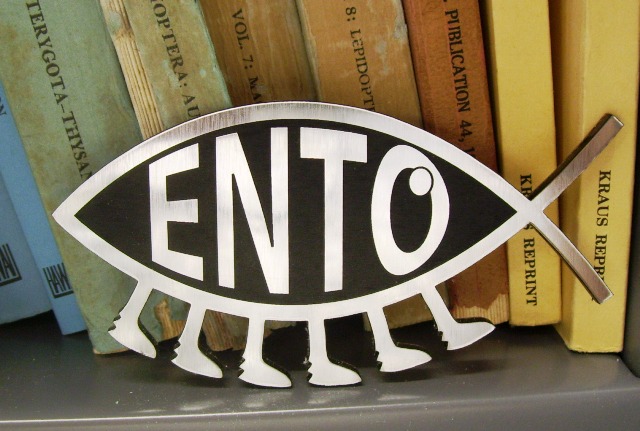
My friend is also an incredible artist, and he vastly improved my original design. I am really happy with how it came out. I’m planning on ordering some more. I’ll probably give a few away for free, so if anyone wants one, post a comment on this blog entry and I’ll send you one in the mail – first 5 comments only. Actually, it may take a while to have more made, so be patient. After you make a comment, email me at http://www.entophile@gmail .com and let me know how I can get the emblem to you. They are about 5 inches long. If you’d like to check my friend’s website where you can have your own custom emblems made, then go to emblemart.com.
Entomology baseball cards
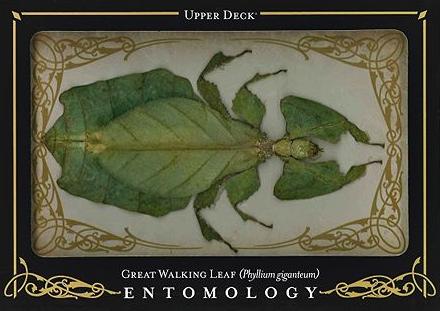
Great Walking Leaf Card (front)
I just read today that Upper Deck, maker of baseball cards and peddlers of various sports memorabilia items, is coming out with a line of Entomology baseball cards. The first card they’ve released for a sneak peek is the Great Walking Leaf, Phyllium giganteum. Evidently on the backside there is a general description with some kind of distribution map. Can’t decide yet whether or not I like these…the look is classic, which is kind of cool, but maybe a little over stylized for my tastes.
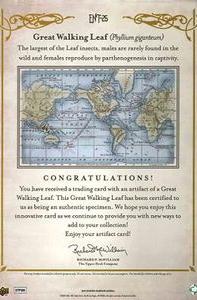
Great Walking Leaf Card (back)
————Update (3 March 2010)—————
OK, so after a little more searching I found that the Entomology cards are part of a trading card set called “Goodwin Champions.”

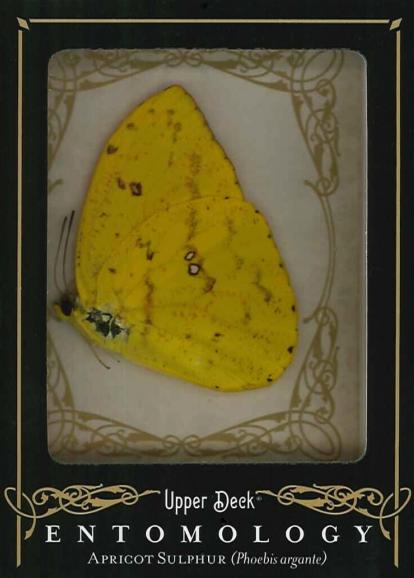
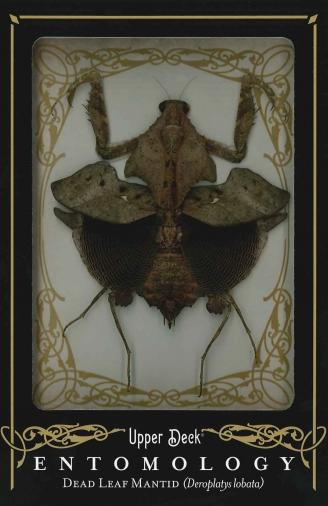
I must confess I have never been into collecting trading cards of any sort, so I am not well versed in the trade, but I think when you order a pack of these cards you get a random selection of the various cards that make up the set – one of which could be an Entomology card. There are 30 Entomology cards total, picturing the following butterflies and other interesting insects and arthropods:
Mexican Silverspot, Spotted Amberwing, Blue Metalmark, Meadow Wanderer, BD Butterfly, Malay lacewing, Painted Jezabel, Sunflower Trollup, Buttercup Sulphur, Spicebush Swallowtail, Pipevine Swallowtail, Strawberry Bluff, Apricot Sulphur, Military Tiger, Cramer’s 89, Bullet Ant, Bottle-brush Longhorn, Man Face Beetle, Rusty Brown Scorpion, Baby Black Scorpion, Fiddle Beetle, Great Walking Leaf, Rosey Walking Stick, Dead-leaf Mantid, Cryptic Mantid, Red Nose Lantern-fly, Minty Walking Leaf, Blomfilds’ Beauty, Blue Brush-foot, Chinese Lantern-fly.
Here are some more sneak peeks-



Zelus renardii (Hemiptera: Reduviidae)
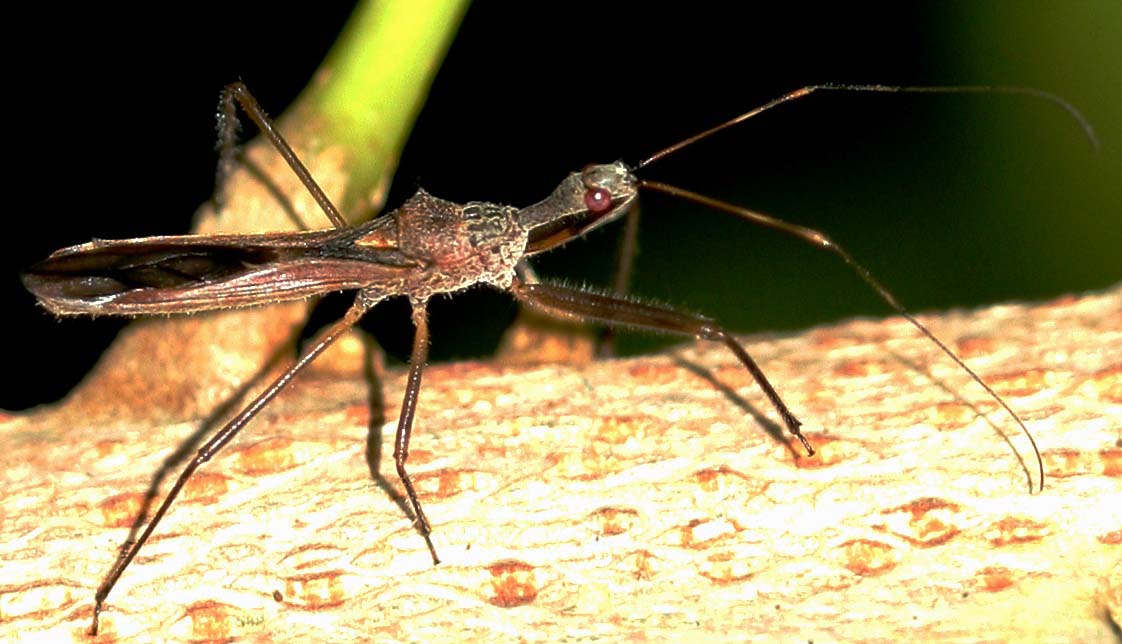
Back in December we did another Hawaiian drosophila survey in Halona Valley, Lualualei. Since the flies we were looking for come out at sunrise and sunset, we had to set up camp at the site. We stayed for two nights and had a great time. The best thing for me, I think, was searching around for interesting insects and other critters later in the night after we finished the fly work. I found an interesting assassin bug cruising around the top of a little tree seedling, and I think I must have watched it for about a half an hour at least. At first I thought maybe it was native, but Steve (Montgomerey) informed that it was a species of Zelus, which is non-native. Nevertheless, I took a few photos.
-

- Zelus renardii

-

- Zelus renardii
-

- Zelus renardii approaches an adult Cixiid
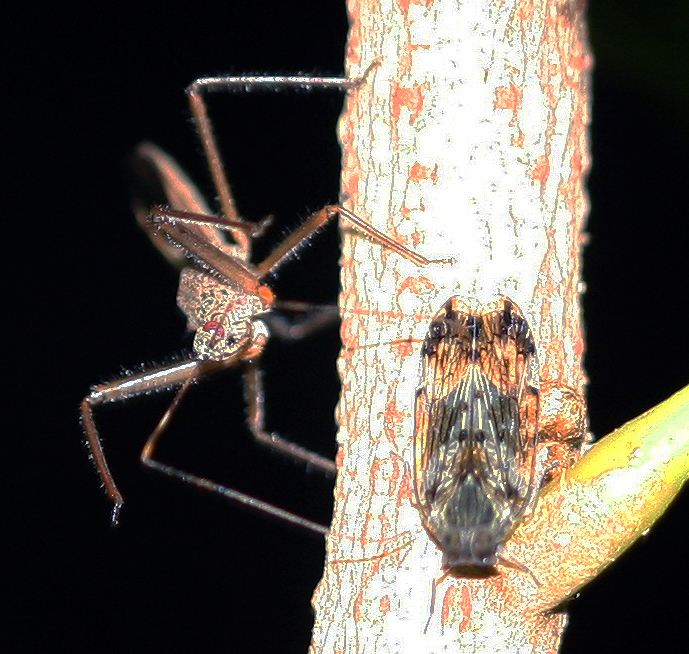
As I was watching, it came upon a Cixiid (Oliarus). I thought for a second, when it reared up (see photo above), that I was going to witness firsthand the effects of an invasive predator on a hapless native plant feeder, but unfortunately nothing happened. The assassin bug apparently didn’t have a hit out on the Cixiid, because it then showed no interest in it. Shortly thereafter the Cixiid took flight – probably a smart move.
From Volume 3 of Zimmerman’s “Insects of Hawaii” (which, by the way, is now online at http://scholarspace.manoa.hawaii.edu/handle/10125/1768 ) we read that there are 3 subfamilies of reduvids in Hawaii: Ploiariinae, Triatominae, and Harpactorinae. I think there are two native genera in the Ploinaiinae, but the other two subfamilies are completely non-native. There is a good chance this info is not quite up to date, since it is from the ’50s, so I wouldn’t take this as verified truth.
My little assassin bug, Zelus renardii, is in Harpactorinae. Evidently it has quite a reputation as a predator of leafhoppers, and over the years has earned the name of “The Leafhopper Assassin Bug.” First found in Hawaii by Perkins in 1897, it is believed to be an immigrant from Western North America.
Flughumor, aka Dead Fly Art, Fly Art, etc.
I’m currently at Naval Air Station Jacksonville for the Armed Services Pest Management Board DoD Pest Management workshop. It’s been a good meeting – many good talks, and it’s always nice to catch up with old friends. During one session, I almost laughed out loud when one of my colleagues from San Diego slid his laptop over and showed some great fly art images that someome had sent him in an email. Here is a sample:
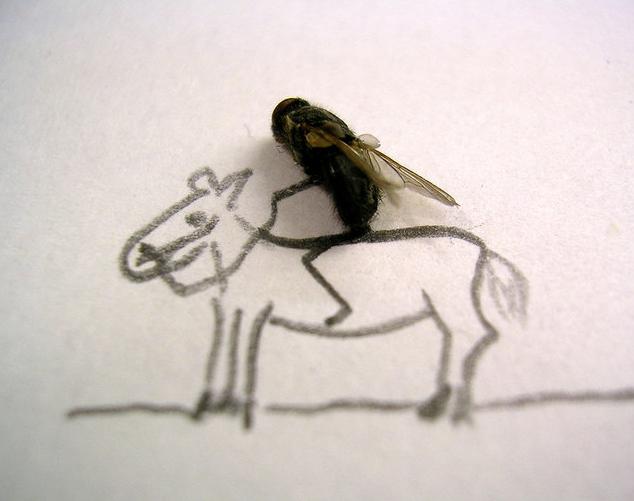
When I got back to my room that evening, I did some surfing on the net and found many more dead fly creations by the same artist. Here are a couple more:


Turns out the creative genius is a Swedish guy named Max Magnus Norman. You can learn more about him at his blog, http://www.blogcatalog.com/blog/art-illustrated-adventures-of-swedish-artist-max-magnus-norman-a-swedish-blog , and you can find more of his dead fly photos, or flughumor (I assume this means “fly humor” in Swedish), at his Fotosidan gallery.
This is a great idea – can’t believe I didn’t think of this first! I’ve already got some ideas brewing for similar dead insect masterpieces…
First conclusive evidence of Jackson’s chameleons feeding on Hawaiian insects and snails.
It’s official, the paper documenting native Hawaiian insects and snails from Jackson’s chameleon stomachs has been published in the online version of the journal “Biodiversity and Conservation.” The title is: “A reptilian smoking gun: first record of invasive Jackson’s chameleon (Chamaeleo jacksonii) predation on native Hawaiian species”, and the authors are Brenden S. Holland, Steven L. Montgomery, and Vincent Costello. (I think the date of publication is 25 December 2009, but you have to look in the “online first” section to find the paper.)
You can see the abstract for free at the Biodiversity and Conservation website, but if you want to read the entire paper, then you have to pay $34.00. I was a little surprised they included a head shot of a dead male Jackson’s in the paper. If there is ever any kind of a depredation program to keep these guys out of native forests, I suspect it will be met with fierce opposition by many folks who have a strong affinity for the cute little beasts. They have kind of become a Hawaiian icon – maybe not quite like the gecko, but they do have a certain status in Hawaii. In light of this, I would hope the Hawaii environmental and conservation community proceeds with caution and tries to exercise some good PR along the way. I don’t think a picture of a dead chameleon sends the right message, but then again its a research paper, not a community bulletin, so it’s probably not a big deal. I guess I am somewhat guilty of the same offense by calling them “killers” in one of my blog entries. Anyway, gruesome picture notwithstanding, I give these guys kudos for getting the paper out. I know both Steve and Vince fairly well and they are both really good guys and extremely good field biologists.
And now a little teaser from their paper (the last two paragraphs of the discussion):
“Much remains to be determined in terms of making an accurate assessment of the threat posed by Jackson’s chameleons in Hawaii, and further work is planned. For example, little is known about their precise range, elevation preference, reproductive season and rate, desiccation tolerance, and prey preference. Jackson’s chameleons occur in lower to mid elevationnon-native forests on Oahu, and have rarely been reported from tree snail habitat, which tends to be upper elevation dominated by native flora beginning around 600 m above sea level. The observations presented provide conclusive evidence that when chameleons are present in native forest where tree snails and other endemic invertebrates occur, they pose a threat.”
“It is possible that due to a number of factors, such as prey availability and distribution, changing climatic conditions, recent population establishment due to pet release or escape, Jackson’s chameleons are undergoing a range expansion into upper elevations. This is a concern for a variety of threatened and endangered invertebrate species, including tree snails (Achatinella spp.), pomace flies (Drosophila spp.) , rare damselflies (Megalagrion spp.), and rare amastrid and succineid land snails, all restricted to upper elevation forests such as Mt. Kaala Natural Area Reserve adjacent to the sampling locality. Prior to this discovery, as part of an ongoing collaborative study, one author (BSH) has collected several hundred chameleons, and gut contents are being examined from populations in the Round Top/Tantalus area of the Koolau Mountains, Honolulu, on eastern Oahu (Whiting et al. in prep). Endangered Oahu tree snail species have not been observed in this region in several decades. It is conceivable that predation by Jackson’s chameleons may have played a role in the local extinction of Achatinella spp. in this area.”
Rambur’s forktail, Ischnura ramburii
I was out at the Niulii ponds (Lualualei Valley) again a few weeks ago, and I had the opportunity to look around and take some photographs. In the small area that I was in, there were a number of interesting insects, but what caught my eye most were some damselflies fluttering around near an area with a lot of seepage. The blue spot at the tip of the abdomen on the males was a quick giveaway that they were Ischnura ramburii (Odonata: Coenagrionidae). I was excited to get some images of the them, because they didn’t seem to mind me being there so I had ample opportunity to get some good shots. Unfortunately, I was reminded of how crappy I am at photography because, for whatever reason, I just couldn’t get any good shots. They all came out a little grainy and not quite totally in focus. Anyway, here are the best shots I managed to get of the male and female:
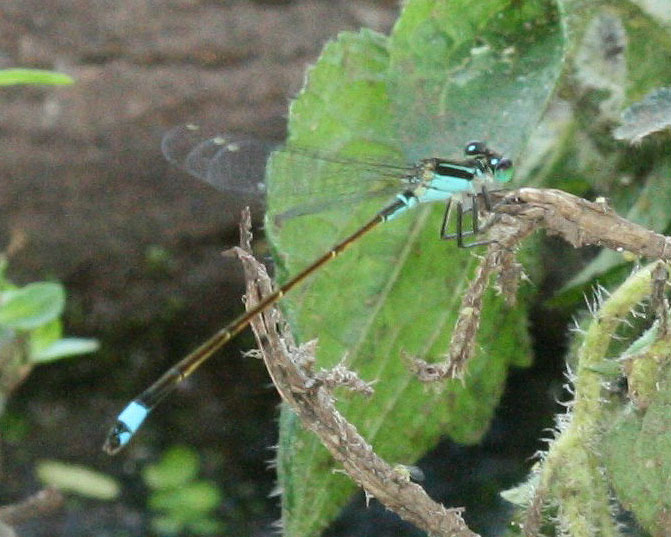

And here is some interesting info from Dan Polhemus and Adam Asquith’s book “Hawaiian Damselflies: A Field Identification Guide” (Bishop Museum Press, Honolulu, 1996).
“Distribution: Originally distributed from Maine to Chile. Introduced to the Hawaiian Islands around 1973, and now known from Kauai, Oahu, Molokai, Maui, and Hawaii. Commonly found along the margins of coastal wetlands, and around ponds at elevations up to 500 ft, but not generally a mountain species.”
“On the North American mainland two distinct female color forms are present, the orange form and a bright green form similar to the male. The latter color form was previously recorded from Hawaii (Hilton 1989), but has not been seen during the last decade, and may have died out in the islands.”
Praying mantis catches and eats hummingbird
I saw this picture in the latest issue (Nov 2009) of National Geographic.

Photo by Sharon Fullingim, published on National Geographic Your Shot
In the Nat Geo article they reference some more pics at BirdwatchersDigest.com of a mantis preying upon a hummingbird…


It always warms my heart to see insects taking down vertebrates, except for the next picture, which makes me a little uneasy…
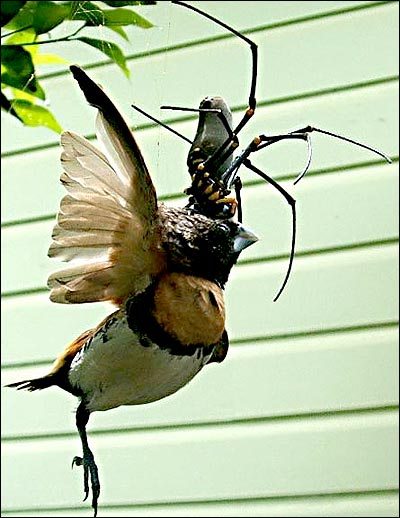
This is a species of spider from the genus Nephila, commonly known as golden orbweavers. The spider shown above is supposedly from Australia, but there is also a species that is relatively common in Florida, Nephila clavipes.
By the way, a couple of Entomologists recently described a new species of Nephila, N. komaci, which is the largest known species of web spinning spider currently in existence. The official reference for their publication is “Kuntner M, Coddington JA, 2009 Discovery of the Largest Orbweaving Spider Species: The Evolution of Gigantism in Nephila. PLoS ONE 4(10): e7516. doi:10.1371/journal.pone.0007516.” According to the paper, body length of the females can get up to 4 cm long. I didn’t see anything about legspan, but according to Nat. Geo. this can be up to 12 cm for the females. Unfortunately, this species is very rare and has only been found in certain parts of South Africa and Madagascar.
 Entophile Shop


 Entophile